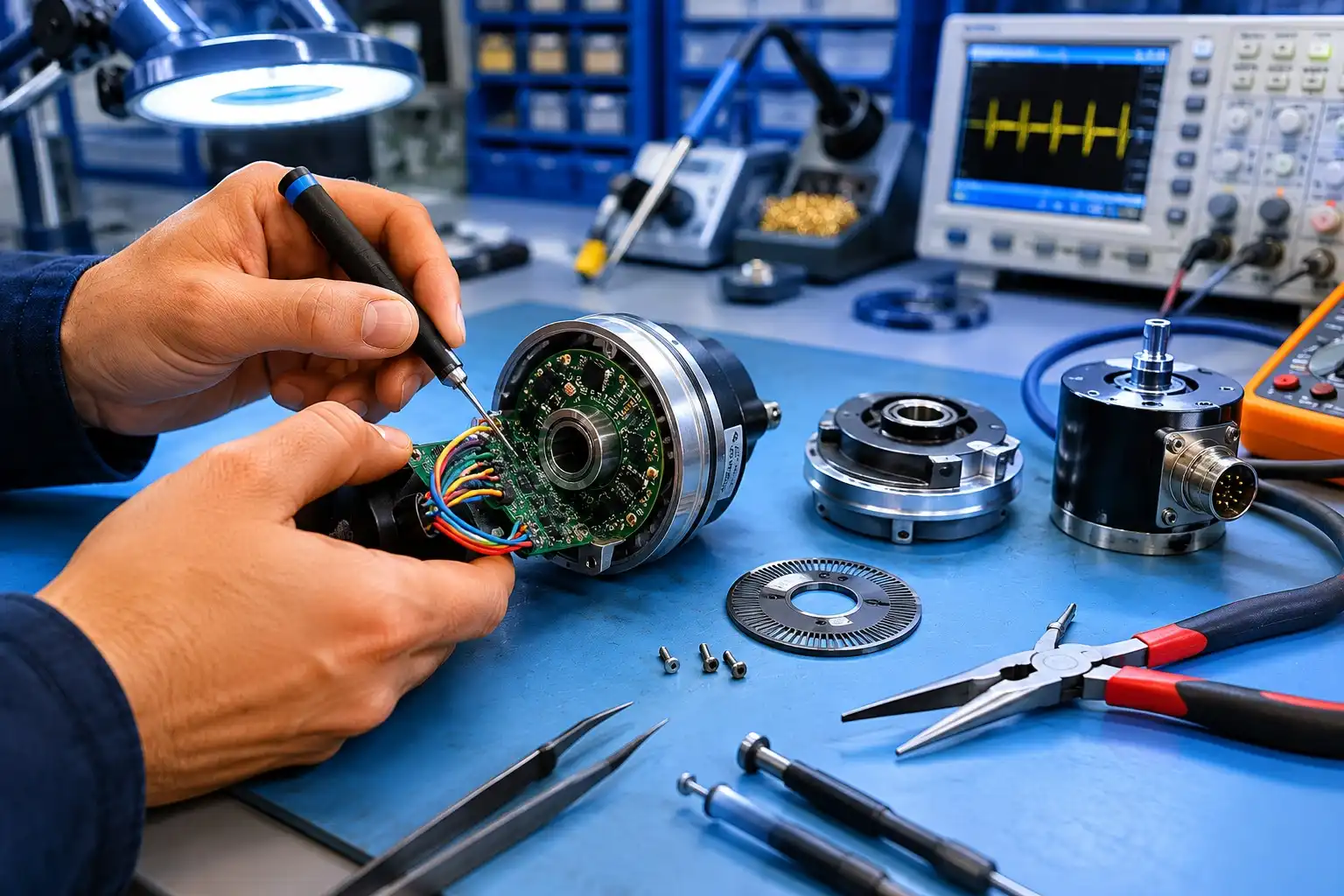
Encoders and Resolvers are "feedback" devices physically attached to the motor shaft under the rear cover of industrial servo motors. As the motor rotates, they calculate the speed, angle, and direction of rotation in a thousandth of a second (millisecond) and report it to the servo drive. These devices allow a CNC machine to cut metal with micron precision and a robotic arm to find its target down to the exact millimeter.
Encoders contain extremely sensitive optical glass disks or magnetic readers. If this system breaks down or the electronic signal (pulse) is distorted, the machine goes blind; the axes don't know where they are going, and the machine goes into an emergency stop, displaying critical errors like "Feedback Error", "Encoder Comm. Fault", "Pulse Loss", or "AL.20" on the screen.
Chronic Encoder Faults We Solve in Our Laboratory
Harsh factory conditions, heat, and incorrect maintenance interventions cause major damage to encoders:
Optical Glass (Disk) Breakage
When the motor shaft is jarred, when the pulley is hit with a hammer during bearing maintenance, or when there is bearing clearance (vibration), the thin optical glass (pulse disk) inside shatters. We replace broken optical disks with original new disks of the exact same pulse and resolution, applying precise focusing.
LED / Optical Sensor Blinding
Especially in CNC lathes and milling machines, coolant (bor oil) leaking into the motor due to worn motor seals seeps into the encoder. The oil layer coats the glass disk, blinding the reader LEDs and photodiodes. The reader circuits are chemically washed, and faulty sensors are renewed.
Communication and IC Failures
Static electricity caused by short circuits in the motor cable or lack of grounding burns out the SSI, EnDat, or Fanuc FSSB protocol chips inside the encoder. The data bus is reopened by repairing the SMD communication chips on the circuit.
Internal Bearing Failure
Independent of the motor's own bearing, some advanced encoders (e.g., Heidenhain ERN series) have their own micro-bearings inside. These bearings seize or disintegrate over time. We provide internal mechanical overhauls and micro-bearing replacements with original parts.
WARNING: What is Zero Point (Offset / Commutation) Calibration?
The deadliest mistake made by amateur rewinders and mechanical maintenance personnel in the industry is this: They have to remove the encoder on the back cover to renew the bearing or winding of the servo motor. When the repair is finished, they simply "screw" the encoder back on.
However, the encoder on the servo motor must be in electronic angular harmony with the magnetic North-South (U-V-W) poles of the rotor! If the angle is connected randomly; the moment the motor is energized, it shoots in the wrong direction, locks up, resonates loudly, and blows up the Drive's power modules within seconds.
While the motor shaft is rotating in our laboratory, the magnetic field of the rotor is read via oscilloscopes, and the electrical Zero Point (Commutation Angle) of the removed encoder is calibrated to the original factory data with milli-degree precision.
Encoder Protocols and Brands We Support
We master all protocols, from legacy Incremental systems to the most modern Absolute and high-resolution data bus systems:
Major Brands We Repair and Calibrate in Our Laboratory:
Heidenhain (ERN, EQN, ECN, ROD), Fanuc (Alpha, Beta, Serial Pulsecoder), Sick Stegmann (SRS, SRM, SKS), Siemens Drive-CLiQ Sensor Modules (SMI), Yaskawa Absolute, Mitsubishi, Hengstler, Tamagawa Seiki, Baumer, Kübler, Lika.