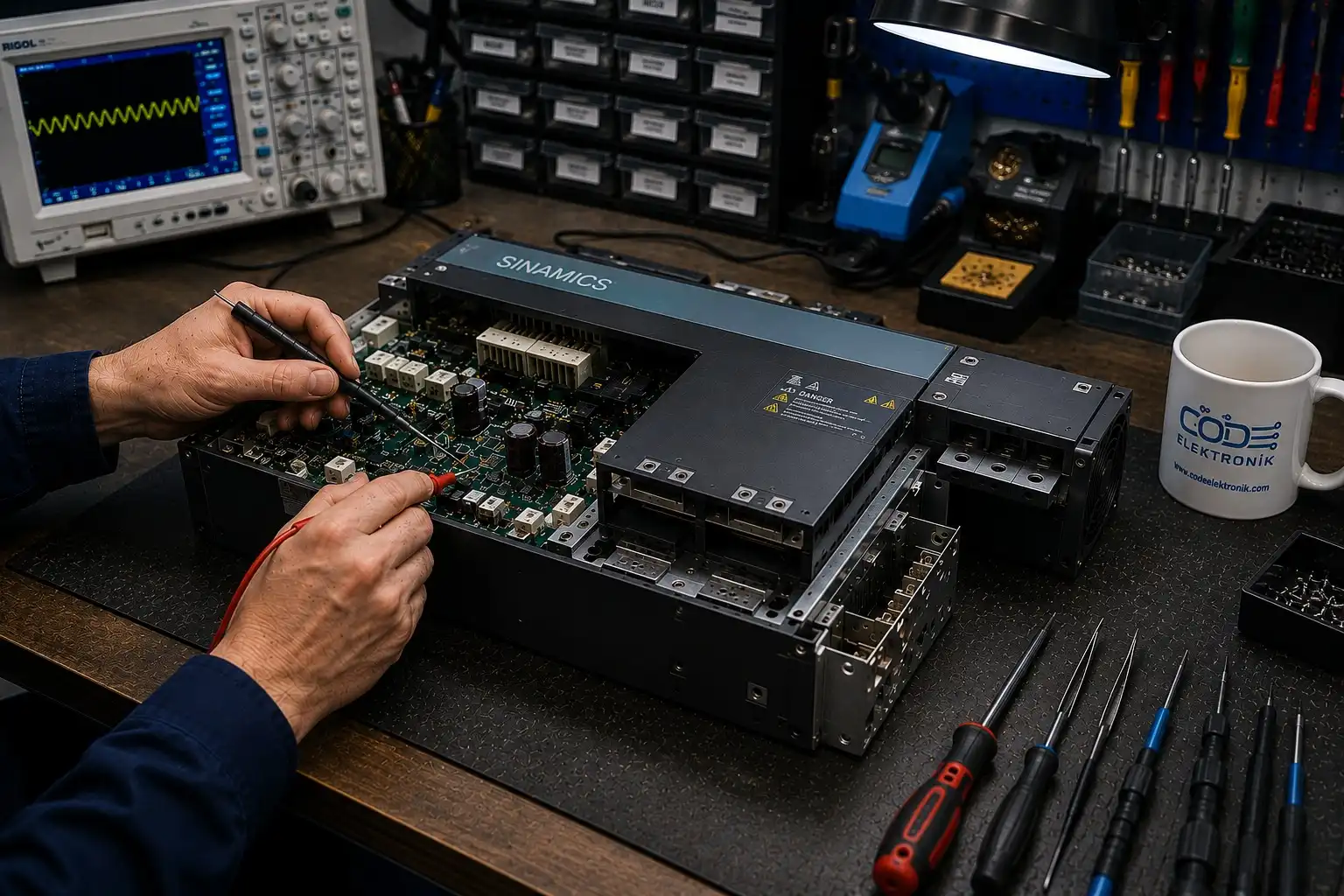
Devices known in the industry as Servo Drives or Servo Amplifiers are electronic power and control units that supply energy to servo motors. They process the signals coming from the encoder (feedback) at the rear of the motor, controlling the precision of movement in milliseconds.
The primary duty of a servo drive is to take the position (X, Y, Z coordinates), speed (RPM), and torque (Nm) commands from the CNC control unit (e.g., Fanuc, Mitsubishi, or Siemens PLC) and translate them into electrical current and voltage. The drive converts the 380V AC voltage from the grid into direct current (DC Bus), then generates PWM (Pulse Width Modulation) signals via power modules (IGBT) to drive the motor in perfect synchronization.
Difference Between a Servo Drive and a Standard Inverter
In the industry, speed controllers (Inverters / AC Drives) are often confused with Servo Drives. Both drive motors, but there is a massive technological difference between them:
- Open Loop vs Closed Loop: Inverters operate in an open-loop; they tell the motor to "spin at 1500 RPM" but do not know if the motor is actually spinning at that speed or where it stopped. Servo drives operate in a closed-loop. They constantly monitor the motor's position via the encoder and make instantaneous corrections.
- Dynamic Response Time: Servo drives have very high dynamic response times. When a robotic arm or CNC axis needs to stop suddenly or accelerate in the opposite direction at full power, the servo drive performs this flawlessly within milliseconds. Inverters are more sluggish, meant for constant speed loads like fans or pumps.
- Full Torque at Zero Speed (Holding Torque): Think of the Z-axis of a vertical machining CNC; even when the motor is not spinning (0 RPM), it needs to hold tons of weight in the air. Servo drives lock the axis by sending maximum current to the motor even at zero speed.
What Does the Internal Structure of a Servo Drive Consist Of?
When we look inside the box, servo drives basically consist of 3 main electronic blocks:
- 1. Rectifier and DC Bus: It converts the 380V or 220V alternating current (AC) from the grid into direct current (DC) via bridge diodes. This current is filtered with the help of high-capacity capacitors, creating a smooth energy reservoir on the DC bus.
- 2. Power Stage (IGBT / IPM Module): It is the "muscle" power of the drive. It takes the energy waiting in the DC bus, opens and closes it thousands of times a second (PWM), and sends exactly the voltage and frequency the motor needs. These power modules are the most frequently exploded and burnt parts in drives.
- 3. Control Board and Communication: It is the brain of the device. It contains microprocessors (DSP/FPGA), chips where parameters are held (EEPROM), and communication ports (Profinet, EtherCAT, Fanuc FSSB optical cable) that allow it to communicate with the machine. The encoder cable from the motor is also connected to this board.
Servo Drive Communication Protocols
Modern drives communicate with PLCs and controllers using high-speed industrial fiber optic or ethernet networks instead of analog signals. The majority of failures occur on these communication boards:
Main Causes of Drive Failures and Error Codes
Drives consist entirely of high-tech electronic SMD components. The main factors causing failures under factory conditions and their reactions are as follows:
Overcurrent and IGBT Explosion
IGBTs (Insulated Gate Bipolar Transistors) are the power muscles that open and close the current going to the motor thousands of times a second. A short circuit (liquid contact) in the motor, mechanical jamming, or high voltage spikes in the grid physically explodes the IGBT module. Usually, an Overcurrent, F30001 (Siemens), or ALM 08 (Fanuc) error is seen on the screen.
Overheating and Capacitor Drying
Dust, coolant mist, or textile lint inside the electrical panel clogs the aluminum heatsink fins and fans of the drive. A drive that cannot cool goes into thermal protection. If it operates hot for a long time, the main DC bus capacitors swell, causing the SMPS (Power Supply Unit) to burn out.
Regenerative Resistor (Braking) Faults
When a servo motor stops suddenly at high speed or lowers a heavy load, it acts like a generator, pushing reverse voltage (electricity) to the drive. The drive converts this electricity into heat over the Braking Resistor. If the resistor line or chopper circuit fails, the device stops giving an Overvoltage error.
Critical Warning: Why is Parameter Backup Vital?
The biggest mistake that can be made when a servo drive breaks down is to immediately dismantle the device, buy a new one, and install it! Servo drives are not "Plug & Play" empty boxes. They contain hundreds of software parameters (Gain, Inertia) specially set according to the machine's motor weight, pitch, and axis brake systems. If these parameters are not read and recovered from the burnt device, or if you do not have a backup, the new device you buy will not run the machine. At Code Elektronik, our biggest expertise is rescuing your machine parameters via chips from burnt motherboards.